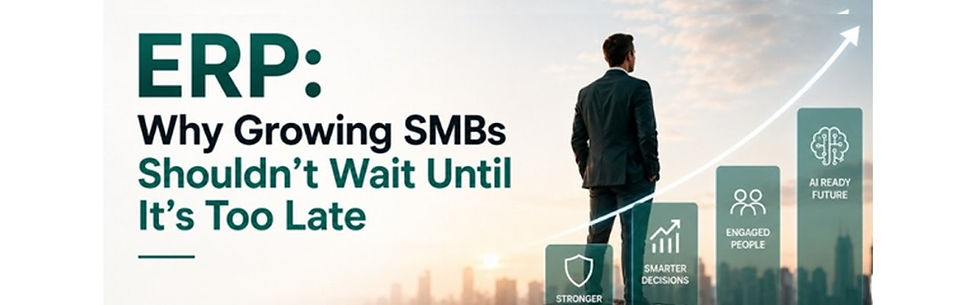
ERP: Why Growing SMBs Shouldn't Wait Until It's Too Late

For many small and medium-sized businesses, ERP remains a daunting prospect. Stories of budget overruns, lengthy implementations, and projects that fail to deliver value often discourage business leaders from taking the first step.
The result? Many organisations delay the ERP conversation until operational challenges become impossible to ignore. Unfortunately, waiting too long can make implementation more complex, costly, and disruptive than it needs to be.
For growing SMBs, there are significant advantages to adopting an ERP solution earlier than many realise. Here are three reasons why.
1. Business Strategy and Long-Term Growth
Most growing businesses ultimately have one of three ambitions:
Acquire other businesses
Be acquired
Pursue a public listing
Each of these paths requires mature business processes, reliable reporting, and access to accurate, timely data. As organisations scale beyond the £5m revenue mark, having finance and operations connected on a single platform becomes increasingly important.
An ERP system provides the visibility and control needed to make informed decisions, support growth, and reduce operational complexity.
For business owners considering a future exit, ERP can also play a role in increasing business value. It demonstrates operational maturity, strengthens governance, and can significantly accelerate the due diligence process during acquisitions or investment rounds.
ERP is not simply a technology investment. It is an investment in scalability and long-term business value.
2. People and Change
Attracting and retaining talented people is becoming more competitive and more expensive than ever. Once you've found the right people, keeping them engaged and productive is equally important.
Modern employees expect modern tools. Relying on disconnected spreadsheets, manual processes, and legacy accounting systems can create frustration and unnecessary inefficiencies.
Today's workforce is increasingly made up of Millennials and Generation Z, many of whom have grown up with cloud-based and digital-first technologies. They expect systems that are intuitive, connected, and accessible from anywhere.
By providing employees with modern ERP capabilities, businesses can improve productivity, reduce repetitive tasks, and create a better overall employee experience. This allows teams to focus on higher-value work rather than administrative overhead.
3. Technology Adoption and AI Readiness
Every business conversation today seems to include two letters: AI.
And for good reason.
Artificial intelligence is helping SMBs access capabilities that were previously available only to much larger organisations. From automation and forecasting to customer insights and decision support, AI has the potential to deliver significant competitive advantages.
However, AI is only as effective as the data that powers it.
If information is spread across spreadsheets, disconnected applications, and manual processes, AI will struggle to deliver meaningful results. Poor-quality data simply leads to poor-quality outcomes.
An ERP system provides the structured, secure, and centralised data foundation required to unlock AI's full potential. By creating a single version of the truth across the business, organisations are better positioned to leverage current and future AI capabilities with confidence.
Final Thoughts
Too many SMBs view ERP as a project that can wait until growth creates operational pain.
In reality, the businesses that gain the most value are often those that implement earlier, before complexity becomes a problem.
ERP does not have to be a risky, expensive transformation. Implemented at the right time, it creates the foundation for growth, improves decision-making, attracts and retains talent, and enables future AI adoption.
The question is not whether your business will eventually need ERP.
The question is whether you'll implement it before or after growth starts exposing the cracks.